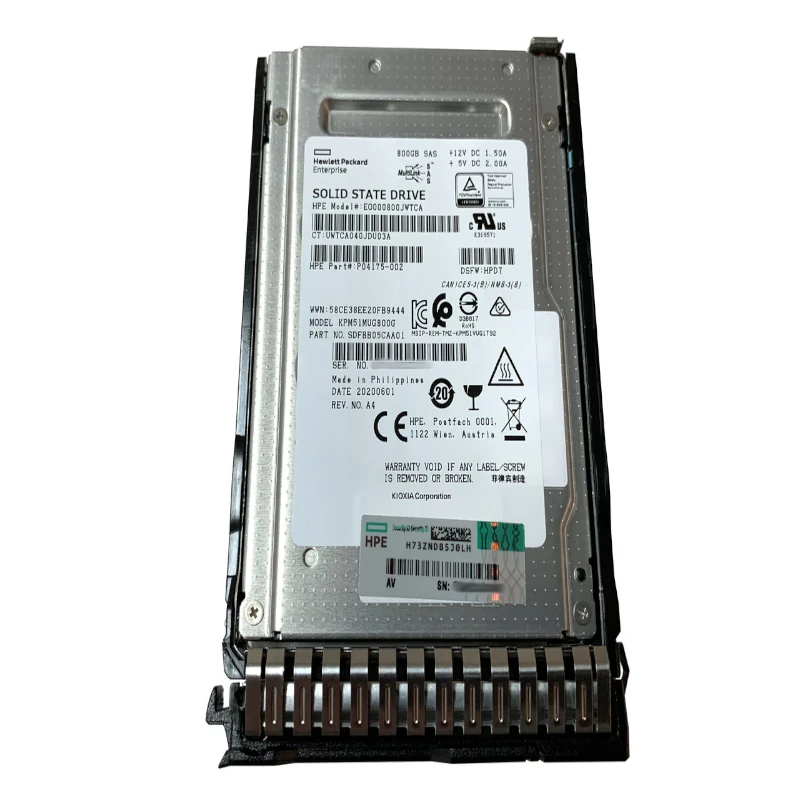
P49324-001 is an assembly reference associated with the HPE 800GB SAS 24G Mixed Use SFF SSD family, intended for component-level identification. The documented product family is 800GB, uses SAS 24Gb/s, and is described as a 2.5-inch SFF Mixed Use solid-state drive with Basic Carrier. This page focuses on installed media audits, rather than repeating the purchasing description of other numbers in the same family. The assembly number helps distinguish a physical 800GB 24G SAS SSD from another drive that shares capacity but not HPE qualification.
Recording the installed assembly
A 24G SAS drive belongs to a newer interface family than 12G SAS HDDs. The correct server and backplane arrangement is necessary to use the intended storage configuration. The part number P49324-001 should be retained in inventory records alongside the server model and the identity visible on the installed unit. That makes future maintenance more straightforward and helps procurement distinguish a commercial option, a spare, an assembly and a model number.
Understanding the 24G interface family
SAS 24Gb/s describes the drive interface generation. A supported controller and backplane are needed for the intended configuration; a drive should not be treated as a direct replacement for older Smart Carrier or SATA media merely because it fits a 2.5-inch bay. In practice, drive selection is a system-level decision: the bay, backplane, controller, firmware qualification and existing RAID design all influence suitability. The most useful product record describes the exact component family rather than only its capacity.
Identification details
| Part number |
P49324-001 |
| Reference type |
assembly reference |
| Capacity |
800GB |
| Interface |
SAS 24Gb/s |
| Format |
2.5-inch SFF |
| Carrier |
Basic Carrier |
| Drive class |
Mixed Use solid-state drive |
Planning for a compatible replacement
A replacement project is often about preserving a known working configuration. For P49324-001, the interface and carrier provide useful clues, but the supported HPE server configuration remains the deciding factor. This is particularly important in mixed-generation estates, where two drives may share capacity yet differ in firmware, tray design or controller requirements.
The P18438-B21 listing illustrates a different identifier or storage family; matching the intended server generation is more useful than comparing capacity in isolation. The aim is to choose storage that fits the current platform and the required workload, rather than to change technology during a routine service event.
Storage capacity and array design
Raw capacity is only the starting point for an enterprise storage plan. RAID protection, available drive bays, future expansion and backup requirements influence the usable result. For P49324-001, recording the installed part and the array to which it belongs is valuable during future repairs. The same record can support stock planning and reduce time spent identifying hardware when a maintenance window is short.
What the interface does and does not tell you
The interface name describes one part of the technology, but it does not identify every compatible server. A drive may be physically similar to another product yet use a different carrier or firmware family. Keeping the full P49324-001 reference, rather than only a generic capacity description, makes quotations and asset records more useful. It also supports a clearer distinction between an upgrade and a like-for-like replacement.
Choosing capacity for the actual workload
A drive intended for active application data may have different priorities from one used for less frequently accessed information. Capacity, write activity, latency and resilience all matter. An established platform can benefit from retaining a known supported storage family, while a major capacity increase may be better handled as a planned storage refresh. Treating those as separate decisions can make purchasing more predictable.
New and Refurbished stock
A New P49324-001 can suit planned upgrades, spare holdings and compatible installations where unused stock is preferred. A Refurbished unit can offer a practical option for maintaining a server already using the same storage family. Actual condition, available health information and warranty should be evaluated for the item offered. The original HPE product-family warranty does not automatically describe a reseller-supplied refurbished drive.
Parts that support further comparison
Related products for storage planning and part-number identification include HPE P49745-001 800GB SSD HPE MO000800PZWSF 800GB SSD HPE P18438-B21 3.84TB SSD HPE P18480-001 3.84TB SSD HPE P18442-004 3.84TB SSD HPE MK003840GYCNQ 3.84TB SSD. Some are alternative identifiers within the same family, while others belong to a different capacity or interface generation. The relationship is useful for identifying components, not a claim that every linked drive is a direct substitute.
Practical use of this part number
The assembly number helps distinguish a physical 800GB 24G SAS SSD from another drive that shares capacity but not HPE qualification. For globally managed server estates, keeping the exact HPE identifier alongside the asset record can simplify future service and purchasing. It also helps teams in different locations understand which component was installed and why it was selected.
Choose the correct HPE storage identity
Euroland IT Store can help source HPE P49324-001 in New or Refurbished condition where available. Share the relevant server and existing part number when requesting a matching storage component, so the enquiry can be handled against the intended platform.
Frequently Asked Questions About HPE P49324-001
What is the purpose of the P49324-001 assembly number?
It is an assembly reference associated with the HPE 800GB SAS 24G Mixed Use SSD family. It helps identify the physical component when an engineer is working from an installed drive label.
Why is assembly identification helpful in a multi-drive array?
It gives technicians a more precise record than capacity alone. This is useful when a drive fails and the replacement must fit an existing server, carrier and storage configuration.
Does SAS 24G guarantee faster applications?
No. The interface can support a newer storage path, but actual performance depends on the controller, backplane, RAID layout and application access pattern.
How should an 800GB Mixed Use drive be evaluated for write-heavy applications?
The workload class is a starting point. Expected daily writes, the product's documented endurance and any array-level write amplification should inform the selection.
Can a Refurbished P49324-001 assembly be used in a production server?
It may be suitable for a compatible system, depending on the organisation's maintenance requirements. The actual drive condition, health and warranty are important considerations.




Reviews
There are no reviews yet.